MycoBabble version 2.0 is underway. Join me at my new location.
October 10, 2011


October 4, 2010
2010 Vacation Mushroom Wrap-up, Part 1
We're back from our annual autumn vacation. This year it was Vermont. The vacation started great with a bunch of edible mushrooms right in the yard, and ended with something else right in the yard - the New Haven river. With water rising we ended the vacation a day early.
Here are some of the fungal highlights (both edible, non-edible and in-between).

Found this nice Polyporus squamosus (Dryad's Saddle) right in the yard. As you can see, we weren't the first to find it... slugs, slow as they seem, ALWAYS seem to get there first. This one had a handful of slugs eating into the cap's flesh. (Those white scrapes are the result.) Field guides often differ on the edibility of Dryad's Saddle. Most will list it as non-edible, but a few claim that the tender edges can be sauteed. One of my wife's edible mushroom guides says that it can be "eaten raw, too, but only in modest quantity." And that "tender slices have a slightly crunchy texture, and the flavor somewhat like watermelon (but without any sweetness). Ummm... wouldn't that be water? Okay, maybe pink water? Anyway, Stacey tried some raw, lived to tell the tale, and reports it was sort of all right.

Also in the yard (and also with a slug or two) was a nice chunk of Herecium coralloides (Comb Tooth). We've often found this in the fall, and this was one of the better specimens. A few tears ago in New Hampshire, we found a massive chunk about twelve feet up in a tree. I found a large branch and jabbed it until it fell. The idea was to catch it. Of course I hadn't really thought through the fact that I'd still be holding the branch when it fell... so how was I going to catch it? As it turned out, with my face. Unfortunately we have yet to find a foolproof way to cook these. We tried. And failed. I mean it was acceptable, but not as good as I read it can be. If anyone has a preferred way to cook these, let me know!

You're walking in the woods, minding your own business, when BAM! there it is. A stinkhorn. This is Phallus ravenelii (Ravenel's Stinkhorn). I have a few photos of these and this is the first where some of the spore mass (that middle shiny band on the head) is still intact. The spore mass is actually what stinks on a stinkhorn. Since the spore mass is sticky, it is unable to disperse the way that many other spores do - via wind. The putrid smell attracts flies and other insects that conduct the dispersal for the mushroom. Stinky, but smart.
Up next: Part 2 of fungal finds.
September 4, 2010
Odds and Ends... But More Odds, Really

Just catching up on a few things I've had sitting around in my iPhoto folder.
This was from a food exhibit we saw at Mass MOCA this past March. Entitled "Mushroom Weightlifter" it was from a series of photographs from the book Food Play by Saxton Freymann.
It's a little creepy really.

And here's another one with a mushroom village and lots of mushroom antics taking place. They obviously like to give each other flowers and dance around. I'd be keeping my eye on that pepper though.
September 1, 2010
What a Lousy Summer...
for mushrooms. Barely any rain, lots of heat. I canceled all the walks I had scheduled over the past few months. There were certainly a few mushrooms to admire here and there, but it's a bit hard to spend 90 minutes gawking over a half-eaten Platterful mushroom. And for those of you reading from afar, I'm referencing the weather in eastern Massachusetts this past summer.
The rains did return (in a big way) a couple weeks back and finally... FINALLY... there are some mushrooms popping up. Probably not enough to save the summer but at least a little something to enjoy.
 This Chicken mushroom (Laetiporus sulphureus) had come up originally in June, as it has in this same spot for the past few years. When the heat came, it quickly dried, turned crumbly white, and decomposed. I thought that was it for the year. But after this recent pounding of rain, it decided to rear its head again.
Let's hope that fall brings more rain.
The rains did return (in a big way) a couple weeks back and finally... FINALLY... there are some mushrooms popping up. Probably not enough to save the summer but at least a little something to enjoy.

Let's hope that fall brings more rain.
May 22, 2010
Orange Trees? Not Quite.

What do you get when you have lots of spring rain, cedar trees, and apple trees? You get an invasion of rusts - in this case, Cedar-Apple Rusts (Gymnosporangium juniperi-virginiana).
Rusts are considered parasitic fungi that attack a variety of hosts. Here, the unfortunate hosts are cedar trees and apple trees. The two types of trees need to be in proximity to each other for the rust to "take." In these pictures taken at the Habitat Education Center and Wildlife Sanctuary in Belmont, MA, the cedars and apples are within fifty yards of each other.

A closeup of the rust shows its jelly-like tentacles or horns sprouting from a hard, acorn-like gall. After a rain, or especially during a day-long mist, these horns come out in all their glory, dangling off the cedars in a spiderish manner. They can easily expand to the size of your fist. After a day or two of sun, they dry up, then return at the next rain. Eventually the hardened galls die but they can stay attached to the tree into the next year or even longer.

The rust doesn't appear in this form on apple tree though. Instead, the apple leaves get orange-brown lesions. The rust reproduces and continues its life cycle by spreading spores between the two trees. This can go on year after year after year.
They are not difficult to see. Here's a few trying to blend in with a tractor... but I caught them.

For additional information, check out the UMass Extension website for a helpful PDF.
May 20, 2010
Mushroom Season 2010 Begins
Sorry for the long delay in posts. I think it'll be a little easier now that the mushrooms have started to appear.
I found this nice patch of Wine Caps (Stropharia rugosoannulata) alongside a trail yesterday. These are one of the first large gilled mushrooms to appear in the spring and with the recent rain, they certainly appeared.

One of the things that's great about most mushrooms is how different they can look over the course of just a few days... or even just a few hours. This is one of the reasons people get so flummoxed when trying to ID mushrooms. In the picture above, you have a fairly "classic" look of the fruiting body - stocky stem, rounded cap, a few nicks and gouges where something's taken a bit (not me!). When we see mushrooms in this stage it's easy to forget that they can also look like -

Wow! That's quite a difference. The once-rounded, bun-like cap flattened, and then began to upturn. What you're now looking at was once the UNDERSIDE of the mushroom. Those blackish crevices are the gills which are usually tucked up inside the cap. Though you can't see it very well, the color of the cap has changed too. Once a brick red, dark brown has lightened to tan.
Notice the ring around the stem. A good ID feature of a Wine Cap. Also, just at the upper edge of the ring is often a dark horizontal line. The spores, as you can imagine from the photo, are a dark purplish brown or purplish black.
Mushrooms are not much like birds. Usually when you see one bird, the others of that species look the same as adults, and by gender. Not so much with mushrooms.
And of course mushrooms tend to sit still.
For more info on Wine Caps, check out MushroomExpert.com
March 17, 2010
A Box Full of Surprises
Most product companies try to keep varying types of fungi from being shipped with their product... ecovative design, a New York-based company is doing the opposite - they want to ship your product WITH fungi.
EcoCradle Packaging is an innovative alternative to the decidedly un-ecofriendly use of polystyrene, packing peanuts, plastic bubble wrap, and paper-based "filler" materials you're often stuck with when you unpack your delivered package.
That's because ecovative design's packaging material is grown. That's right, grown, with vegetative hulls. In just 7 days, miles of mycelia (mushroom roots, if you will) are produced, harvested, molded into a packing shape, and ready to accompany your favorite internet order.
Now I'll be the first to admit that this sounds suspiciously like the beginning of quite a few monster movies. Some crazy scientists (or government agency) holed up somewhere, discover a new process for doing something they think will help mankind... a beaker spills, a lightning storm, and BOOM!, you've got blood gushing everywhere and teenage couple being slaughtered in the woods.
 So I contacted ecovative and requested a sample (for the good of mankind, of course). It arrived the other day, and though it wasn't a large sample, you can definitely see where they're going with this.
The mycelial "chunk" is light, surprisingly sturdy (I can pinch it between my thumb and forefinger... I hear a slight crackling sound, but I can't shatter it) and is somewhat attractive (as fungi goes). Both my wife and I did the same thing after first eyeing it... we smelled it. I mean if it were to smell like a old sock in a waterlogged basement, you probably wouldn't want your brand new Amazon package smelling like it, but was pleasantly surprised that it didn't smell like anything.
It's appearance reminds me of the Oyster Mushroom kit I buy once a year for the home school classes I teach (minus the actual mushrooms of course.)
 The sample that I was sent was too small to actually use for packing material, but I did take a picture of one of my rubber apes in the box with it. I wouldn't hesitate at all sending Stamp Ape (well, that's his name) through the mail with this stuff. (Actually for now, it'll act as a nice little table for when he has his other ape friends over.)
With a recent article in Scientific American, and a nod as one of the 100 best innovations of 2009 by Popular Science, it appears this melding of fungi and sustainability may be in a box heading your way. You may want to peruse their website to get the full picture. My favorite part is from their FAQ:
Q. Can you eat it?
A. Well, you could, and because it's all natural it wouldn't hurt you. But, it's non-nutritious and doesn't taste very good, so we don't recommend it.
March 6, 2010
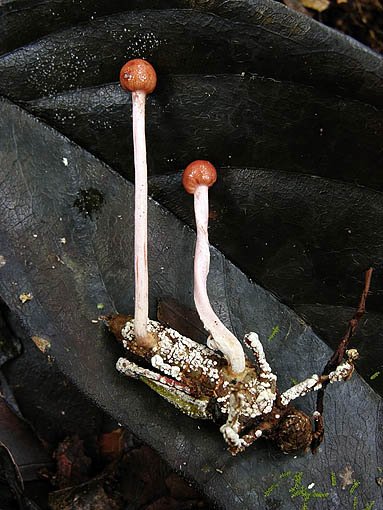
Cordyceps 1, Ants 1

Well it seems the ants are fighting back, sort of. Tired of this abuse, and certainly tired of being turned into zombies to do the bidding of a fungal overlord, recent studies, including a recent one by the University of Regensburg, Germany show that many ants, once affected, "desert the nest in the hours or even days before they died and made their way to a distant foraging area, where they died alone, away from the other workers. They left voluntarily, and were not forcibly removed by other worker ants." This seemingly selfless act appears to slow/prevent the fungus from spreading to other ants.
Ants have always had an interesting relationship with fungi. Leafcutter ants actually nurture and harvest different types of fungi.
We'll see what comes next. Perhaps this.
January 19, 2010
To Wash, Or Not to Wash
That is the question...
It's up there with some of the great conundrums: Paper or plastic? Invisibility or the ability to fly? Ginger or Mary Ann? Should you wash your mushrooms before cooking/eating them?
 Growing up, I liked to make salads for my family. I'd wash, peel, and cut the vegetables, toss them in a bowl with half a bottle of Marie's Thousand Island dressing and place them out for my family. But what of the mushrooms? I was taught to wash and dry them.
But in the years since I've been chastised for such a culinary error of judgment. Don't get the mushrooms soggy! They'll be slimy! Mushrooms absorb water so they'll taste like WATER! Don't ruin them! Don't take one step closer to the sink with that bowl of mushrooms or you'll be walking home to Milbridge tonight! Actually that last one is part of another story.
So I haven't been washing them. I usually take a damp paper towel, wipe off the dirt (or other unidentifiable grunge if they're foraged) and prepare to cut.
Felicity Cloake at guardian.co.uk has thrown her hat in the ring and written an interesting (and highly entertaining) article about this very question. Calling up research from some of our great culinary minds, she not only tackles the question but puts both methods to the test. In one corner, the thoroughly washed and in the other, the thoroughly whisked. It's a taste test for the ages.
Her result? Well, you'll just have to read it.
Okay, okay... if you don't like clicking links I'll tell you that she found the washed lot slightly juicier. An exciting verdict? Not really. But hey, it's the middle of January in New England and it's snowing. I can't exactly go outside and look for chanterelles, so you'll have to take what you can get.
December 22, 2009
Merry Christmas from MycoBabble... I Think
 It seems that this Christmas ornament recently sold on eBay for $76.00. Auctioned as a "realistic" mushroom ornament, it appears to be a carved bolete with large oatmeal-like mounds pasted to it. Oh, with eyes. There aren't any boletes that I know of with red caps with white spots. Or eyes.
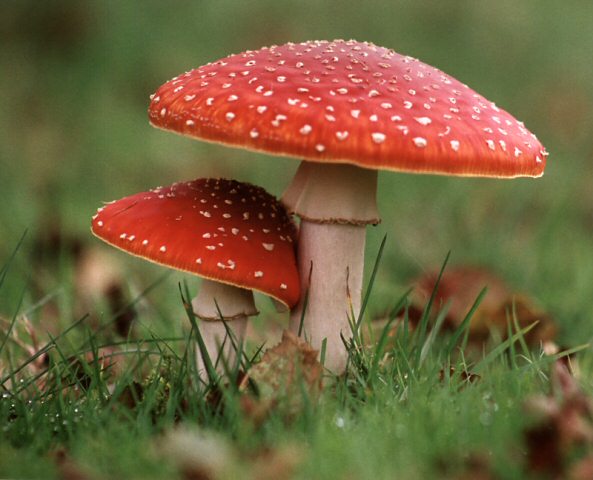
But really, this is meant to be an Amanita muscaria (Fly Amanita). You know, the mushrooms commonly featured in children books and fantasy landscapes. You know, the ones with thinner stems. And a fleshy ring. And a multitude of small, white spots. You know, the ones without eyes.
But really really, the full description on eBay states this is a "realistic Mario mushroom" ornament... from the line of Mario video game and cartoon characters. And though I'm often familiar with video games featuring fungi, Mario is a little after my time.
But you can see a nice collection of Mario Mushroom pictures here on Google images. So if that's the criteria, then yes, this is a very realistic mushroom tree ornament.
December 3, 2009
MycoBattle!
As I've mentioned in this post and this post, I'm a big fan of video games where you wander around in armor and your diamond sword +3, looking for things to crush. You know, Acid Grubs or maybe an army of Murderous Cows... what's even better though, is if that game has mushrooms.
Enter The Sword of Fargoal, a new iPhone game based on a classic dungeon crawler from the 80's. Again, the object is to make your way through the dungeon floors... looking for something I suppose. Probably the Sword of Fargoal. Don't know... haven't made it so far yet.
But along the way... you guessed it. Evil Mushrooms.

Much like in real life, these fungi don't move around too much. In fact they just kind of sit there in the dirt waiting to be crushed. You can stomp on the smaller ones (letting out a satisfying crunch or squish) but the bigger ones you can't pass unless you engage in battle.
Most of the time they just kind of wilt and crumble. You get your experience points and journey on, but occasionally they do fight back. Not with maces or a wizard's dagger +1, but with...
Confusion!

That's right. As you can see my character has been turned into some sort of Jabba-The-Hutt snowbeast thing. And I don't even know what that pink, trumpet-faced, seahorse thingie is. Or that orange blobby goo. It's all quite confusing.
And thus ends another important look at the dangers of mushrooms.
The Sword of Fargoal is currently available for $2.99 on the iTunes app store. You can visit the developer's website at http://www.fargoal.com/.
November 22, 2009
Review: The Observer's Book of Common Fungi
 I have a lot of mushroom guides. They come to me in different ways - I buy them, I bid on them on eBay, I receive them as gifts, some have been left in my work mailbox by anonymous donors... but the source of many of the hard-to-find, international, and just downright bizarre books have been those found by my friend, Elizabeth at the bookstore she works at. I've got a pile of them. Most of them are fairly outdated in the sense that the science of mycology has passed them by, either by new discoveries or by classification changes.
But they're fascinating nevertheless.
The Observer's Book of Common Fungi was published in 1958 by Frederick Warne & Co. LTD, as part of an Observer series that included editions on Pond Life, Larger Moths, Railway Locomotives of Britain, and Cacti and Other Succulents, among others. The authorship is credited to E.M. Wakefield and includes one of my favorite features of older guides - full color plates. In this case 32 of them. The descriptions listed in the book, about 200, are British species, though many of them can be found elsewhere.
Wakefield's Introduction begins -
"Soon after the first warm rains of autumn have softened the soil, the floors of our woodlands become carpeted, as if by magic, with a wealth of toadstools, large and small, brightly coloured or sinister-looking, sometimes strange in form, often beautiful."
The Introduction goes on to cover spore germination, life cycles, spore prints, classifications, in descriptions that are wonderfully concise. The 200 individual species descriptions have a personal tone to them and are often written in one long paragraph. Of the Shaggy Ink Cap, he writes -
"This well-known fungus needs little description. It comes up in groups on rich ground in late summer and autumn, and at times becomes a pest on bowling greens and tennis courts which have been laid out over ground containing rubbish ('made ground')."
Many fungi books of this time solely concentrated on mushrooms that were of the traditional cap and stem variety. Here, he is able to sneak in a few pages on shelf, stinkhorn, coral, bird's nest, and other sundry fruiting bodies.
Overall, this is a fun little book. Personable, (Wakefield refers to the Horn of Plenty as "sombre-looking") and informative, and coming in at about 100 pages and measuring an easily pocketable 4x6, it is worth keeping (or adding) to any mycological collection... even if it did have its 50th birthday last year.
November 16, 2009
Wanted... Fungi Specialists

In August of 2008, Nicholas Evans, author of The Horse Whisperer, and three friends, including his wife, consumed Cortinarius speciosissimus, a deadly mushroom, sometimes known as a Deadly Webcap. They had mistaken them for chanterelles in the Scottish countryside.
For the past year the four of them have been on dialysis in renal units in the United Kingdom and are currently on kidney transplant lists. Their conditions require 15 hours of dialysis a week. Of course, many people are poisoned by mushrooms each year. Often, the culprit are lookalike mushrooms, or the incorrect assumption that what one sees in a field guide is going to be what was picked, or just the lack of importance being placed on the toxicity of a select bunch of mushrooms.
What this article in last week's Scotland On Sunday website focuses on is the lack of proper experts to identify mushrooms in Scotland.
What I think this event points out is that there are still lots of people who take unnecessary chances, combined with lots of wives' tales and misinformation about mushrooms. Look no further than the comments section of the Scotland on Sunday article where "Commentator #4" calls people idiots and then proceeds to quote one of the biggest mistruths about poisonous mushrooms, only to be (rightfully) chided and corrected by "Commentator #7."
Know your mushrooms.
November 9, 2009
Featured Mushroom #5: Cyathus striatus
Common Name: Striate Bird's Nest
 From my experience tromping around in the woods, this is one of the more common, but less spotted mushrooms. Actually if you have mulch or wood chips bordering your yard, there's a good chance these little fruiting bodies have been right under your nose. I've occasionally even found these growing in potted plants.
Measuring about a centimeter, high and wide, these bird's nest mushrooms blend in quite well with twigs, paths, and leaves. The picture to the right shows them from the top down. They are not your traditional "cap & stem" mushrooms, rather they are shaped like little cups, or thimbles (for those of you who may remember what a thimble is). Located at the bottom of the "nest" are the "eggs." Not real eggs, but peridioles, where spores are enclosed.
As you can also see in the picture, some of the bird's nest mushrooms are white on the top. These are ones that haven't completely matured. When they do, that whitish sheath will split exposing the peridioles. (The bottom-most one in the photo shows it quite well.)
There are several types of bird's nest mushrooms in New England, including Cyathus stercoreus (Dung-Loving Bird's Nest). Commonly, the bird's nest mushrooms are also referred to as "splash cups." Unable to actively disperse their spores like many of their woodland counterparts, they rely on other methods including rain splashing in, and splashing out the spores!
Cyathus striatus (from the Latin, meaning "with stripes") has telltale striations running vertically the length of the mushroom. To get more info, you can visit MushroomExpert.com. And there's a great photo at morelmushroomhunting.com.
Photo taken at Mass Audubon's Habitat Sanctuary in Belmont, Massachusetts, July, 2004.
November 2, 2009
Can We Get Our Priorities Straight?

Okay, you're on a bus. You've paid a fare and you're being driven to a destination with a bunch of other people. What have you paid for? Well, the convenience of not having to drive yourself (or walk), the fuel...
But did you consider that you might get something else on your ride... like a special prize? Or a treat? How about some edible mushrooms? Say, some Oyster mushrooms?
You'd be happy, right? Well not these folks. It seems that they're complaining that mushrooms were growing out from under the seats.
Like that's a bad thing.
One of the passengers actually had the courage to snap a picture of the offending fungi and went on to say that his children often take this VERY bus. He went on to say-
"If they'd been there they could have touched them, and mushrooms can cause disease or even poison people. Even if it's not poisonous, what does this say about the cleaners? I pay £54.90 per month in fares, which is a lot to be travelling home on transport with mushrooms growing out of it."
Again... that's a bad thing?!
Talk about a Magic Mushroom Bus...
October 24, 2009
How to Avoid Being Attacked By A Mushroom
 Eat your 3 meals a day! That would be breakfast, lunch, and dinner. Or breakfast, dinner, and supper if you grew up with me in Maine.
It seems New York City's Albert Einstein College of Medicine at Yeshiva University is reporting that by listening to what your Mom said, you can avoid mushroom attacks... okay, actually not really mushrooms, but the smaller, less-understood, somewhat-less-exciting-for-a-blog-post, fungi.
By keeping our normal 98.6º internal temperature, we can fight off any fungal nasties that are looking to take up residence in our bodies. That high of a temperature keeps the majority of fungi attackers at bay. By keeping our food intake up, we are replenishing ourselves with the proper energy to prevent these invasions. The study also suggests that this could be a factor in why mammals rose to dominance after the dinosaur extinction. (Which of course is just a prelude to the day when fungi rise to dominance and throttle us out in the woods - that picture to the left is quite accurate.)
Editors note - That last sentence is not actually part of any study conducted by the good folks at the Albert Einstein College, just a prediction made by most
October 13, 2009
Mushrooms Wait For No Man...

Or bittersweet as evidenced in this photo I took recently.
This is a Lepiota growing in a pile of woodchips near a meadow. Recently there had been invasive species removal where a lot of bittersweet had been pulled up. Bittersweet roots are bright orange (a great identifier if you have this pesky plant invading your yard.) As you can see, the bittersweet seemed to "reroot" itself, just as the Lepiota was coming up. The mushroom, growing at a much faster clip, shrugged it off and decided to "reroute" its growth.
Not quite as dramatic as Godzilla vs. Megalon, I'll admit, but it's a nice glimpse into the mushroom world.
September 27, 2009
Featured Mushroom #4: Hygrocybe marginata
Common Name: Orange-gilled Waxy Cap
Don't adjust your monitors! Sometimes mushrooms are hard to see, barely popping up, camouflaged in with the leaves and branches. When I lead walks I often get asked, "How did you see that mushroom?!" I guess after years of looking for our little fungal friends, you develop an eye for them. A mushroom eye, if you will. (Not to be confused with a cauliflower ear.)
No mushroom eye was needed for this one however. There, coming up amongst the ferns and a patch of partridge berry, were a handful of Orange-gilled Waxy Caps. Just an inch or two high, their bright yellowish-orange color betrayed them on the forest floor. The waxy cap is a good name for many of the mushrooms in the Hygrocybe family as they look to be built from candle wax or some of those lousy, waxy candies we had as kids. Hygrocybes come in many shades of reds, yellows, oranges, whites, and even green! (Parrot Waxy Cap).
You can get more info on the Hygrocybes, along with a bunch of cheery, bright photos, at MushroomExpert.com.
Photo taken at Mass Audubon's Habitat Sanctuary in Belmont, MA. September, 2003.
September 21, 2009
New Hampshire Haul 2009
We just wrapped up our annual fall New Hampshire vacation. We pushed it up a month this year and were happy to find the mushrooms were more plentiful in September.

We had good luck with Chanterelles (both Cantharellus cibarius and Cantharellus tubaeformis). For the record we preferred the C. cibarius. We cooked some up with onions, homemade bread, and a cheese sauce.
It may have been a bit early for some of the tooth mushrooms that we typically find in October, like Hericium americanum (Bear's Head Tooth) and Hydnum repandum (Hedgehog mushrooms) but we found a couple and cooked those up too.
What there were PLENTY of this year were Craterellus fallax (Black Trumpets.) It's amazing how difficult they are to see. They blend in quite well with a typical New England forest floor. They key is looking for the ones which have turned completely black and are decomposing. You don't really want those, but if you look in the vicinity of the old, you will probably find the new - little vase-shaped mushrooms, usually grey with the top opening turning black. You may also see a hint of pink in younger specimens. There was a stretch of trail where we couldn't walk 20 feet without finding another patch. Our bag filled quickly. We ate a few but brought the majority of them home where they'll be cleaned, dried, and stored. They reconstitute well and can be added (cooked) to all sorts of recipes and sauces.
But it wouldn't be a wild mushroom report without an update on the search for the elusive king of the forest - the King Bolete. Boletus edulis. The standard by which all gourmet mushrooms should be judged. Heck, it's even an item in World of Warcraft, requiring your character to be level 45 and seated if you want to eat one.
Here in the real world, we haven't had a lot of success finding them. But on our last day hiking, there, smack in the middle of the trail, was what sure looked like a King Bolete... a brown bun-shaped cap, a stout tannish stem. But we've been fooled before. There's the dastardly Bitter Bolete. From a distance we often get fooled by some Leccinum. Or much worse, you do find a King Bolete but you were beaten by the maggots that found it first. Now in our case, a few fly youngsters (much more appealing than the m-word) indeed did find it first. The stem was pretty much useless and a few sections of the cap had to cut away but we were left with the majority of it. A few hours later we sauteed it in butter with salt/pepper and enjoyed the week's true prize. Delicious.
In addition to what's pictured we also found a nice variety of non-edibles including Fairy Stools, Earth Tongues, Spreading Cups, and a few poisonous Amanitas.
All in all, a pretty good bounty.
Note - A thank you to those of you who have taken the time to post a note in the comments section. This blog is definitely easier to keep up when I know there's actually a few people reading it. Thanks!

We had good luck with Chanterelles (both Cantharellus cibarius and Cantharellus tubaeformis). For the record we preferred the C. cibarius. We cooked some up with onions, homemade bread, and a cheese sauce.
It may have been a bit early for some of the tooth mushrooms that we typically find in October, like Hericium americanum (Bear's Head Tooth) and Hydnum repandum (Hedgehog mushrooms) but we found a couple and cooked those up too.
What there were PLENTY of this year were Craterellus fallax (Black Trumpets.) It's amazing how difficult they are to see. They blend in quite well with a typical New England forest floor. They key is looking for the ones which have turned completely black and are decomposing. You don't really want those, but if you look in the vicinity of the old, you will probably find the new - little vase-shaped mushrooms, usually grey with the top opening turning black. You may also see a hint of pink in younger specimens. There was a stretch of trail where we couldn't walk 20 feet without finding another patch. Our bag filled quickly. We ate a few but brought the majority of them home where they'll be cleaned, dried, and stored. They reconstitute well and can be added (cooked) to all sorts of recipes and sauces.
But it wouldn't be a wild mushroom report without an update on the search for the elusive king of the forest - the King Bolete. Boletus edulis. The standard by which all gourmet mushrooms should be judged. Heck, it's even an item in World of Warcraft, requiring your character to be level 45 and seated if you want to eat one.

Here in the real world, we haven't had a lot of success finding them. But on our last day hiking, there, smack in the middle of the trail, was what sure looked like a King Bolete... a brown bun-shaped cap, a stout tannish stem. But we've been fooled before. There's the dastardly Bitter Bolete. From a distance we often get fooled by some Leccinum. Or much worse, you do find a King Bolete but you were beaten by the maggots that found it first. Now in our case, a few fly youngsters (much more appealing than the m-word) indeed did find it first. The stem was pretty much useless and a few sections of the cap had to cut away but we were left with the majority of it. A few hours later we sauteed it in butter with salt/pepper and enjoyed the week's true prize. Delicious.
In addition to what's pictured we also found a nice variety of non-edibles including Fairy Stools, Earth Tongues, Spreading Cups, and a few poisonous Amanitas.
All in all, a pretty good bounty.
Note - A thank you to those of you who have taken the time to post a note in the comments section. This blog is definitely easier to keep up when I know there's actually a few people reading it. Thanks!
August 27, 2009
3 Days in the Life of a Mushroom
Or more appropriately, 3 Days AS the Life of a Mushroom. This is a terrific time lapse video that I've been using to highlight the short, sweet, and sad I think, life of a mushroom. (Of course the mycelium is still alive in the rotted wood, and may continue to shoot up these Coprinus mushrooms for some time to come.) The added music is a nice touch.
Thanks to nshack for taking the time (3 days time!) to create this.
3 Day Fungus from nshack on Vimeo.
Thanks to nshack for taking the time (3 days time!) to create this.
Subscribe to:
Posts (Atom)